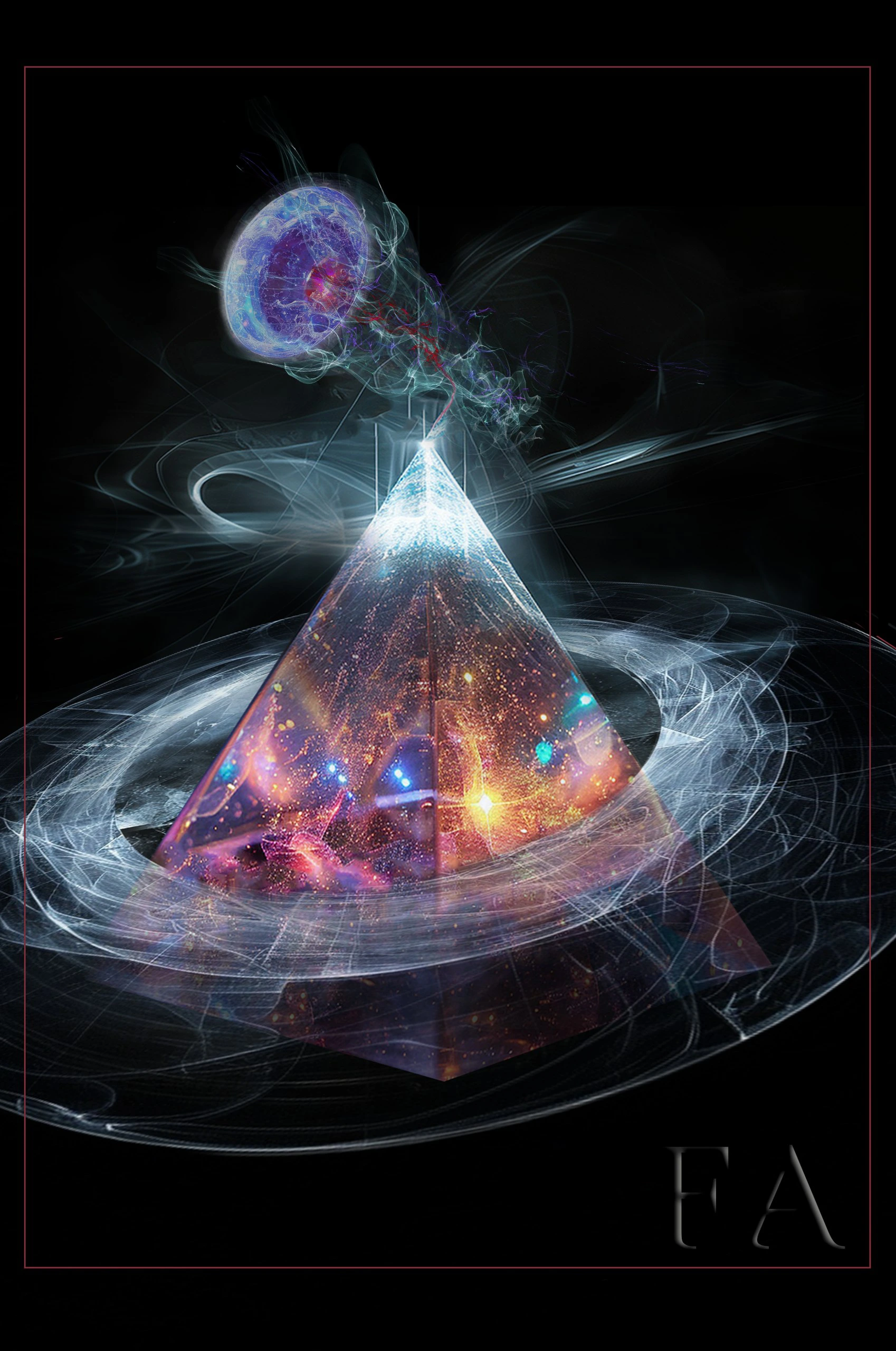
If I look for the person whose language comes closest to what I do on canvas, it is Carl Gustav Jung. Not because I agree with everything he said, but because he was the first among the great minds of the twentieth century to say it out loud: the soul has a form, and that form can be drawn.
I have nothing to settle with Jung. An argument begins where people believe there can be only one correct model — the one you must fight for. I don’t believe that. Every model matters and can be put to use. There simply is no ideal one, because each person has their own, and a model becomes a map only once you have built it yourself. Jung is one of the strongest lenses we have. But a lens is not an eye.
What Jung saw
Jung noticed that beneath the personal «I» lies a layer common to all people — he called it the collective unconscious. And that layer is populated not by thoughts but by images that recur across every nation and every age: the shadow, the self, the mother, the path. He called them archetypes.
One of these images is the mandala: a circle with a centre, symmetry gathered around an axis. Jung observed that a person in crisis often begins, without knowing any theory, to draw circles — as if the psyche, when it is being torn apart, reaches on its own to gather itself back into a form. For Jung the mandala is not decoration. It is an instrument the soul uses to put itself back in order.
This is where he and I stand on the same ground. My works are built on sacred geometry — circles, axes, proportions. That is exactly an attempt to give the soul a form it can lean on. Jung understood this a hundred years before many did: the image works because it is older than words.
Where Jung’s model is not complete for me
And now, honestly, with no argument — just as it is. Jung’s model is brilliant, but like any model it has an edge.
First. For Jung the archetype is universal: the mandala means roughly the same to everyone because it connects you to a layer shared by all humanity. I see it differently. The same geometry gathers a different state in each person standing before it. There is no single map that fits everyone. A painting becomes your map not the moment you learn its «correct» meaning, but the moment you read it yourself.
Second, and this matters more. Jung called us to make the unconscious conscious — that is, to uncover and gather what already lies in the depths. That is enormous work, and I respect it. But I go not only inward, I also go forward. Love, for me, is a state when it’s possible to create your own reality, not only to sort through the reality already accumulated. Jung teaches you to find yourself. I want you to create yourself as well.
This is not «Jung was wrong». It is exactly what I began with: even the strongest model is not the end. It is a lens. You draw your own map regardless.
What this means for you
I’ll say it plainly, with no promises: a painting will not put your soul in order for you, and it heals nothing. To hang a mandala on the wall and assume you are now gathered inside is self-deception.
But a good work knows how to be a mirror. You look at a built form — and for a second your own scatteredness pulls toward its axis. Not because the painting «heals», but because it is hard to stay in chaos in front of an honest form. The rest is your work: to gather your own map out of that moment.
And still
Jung gave us a language in which the soul can be spoken of without embarrassment — the language of image and form. Below that bar, talk of «the spiritual» already feels awkward.
So I will not hand you a finished mandala, nor tell you what it means. I will give you a form and take my hands away. Stand before it and ask yourself: what does it gather in me? The answer will be yours alone — and that is the only map that works. Jung showed that the soul can be drawn. Who draws it for you — that is for you to decide.
The work in question — «Centre» →
— Evgeny Fleysher
Artist and engineer. Author of WHY? and The Spiritual Alphabet, creator of the Art as Healing project. Paints works built on sacred geometry.
About the author and the method →