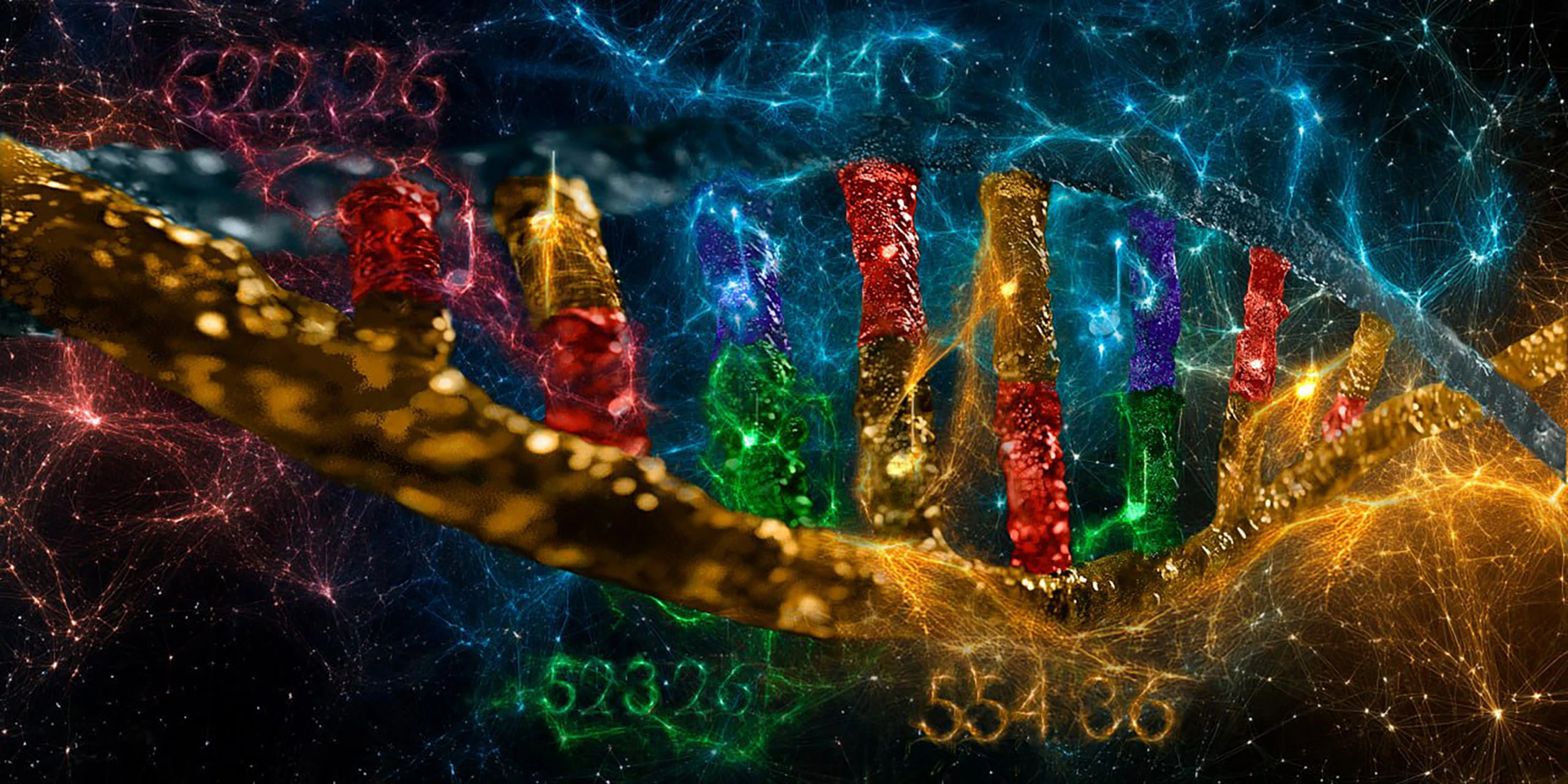
A random composition sometimes lands. A composition built on geometry lands every time — and the landing can be repeated. The difference between them is not taste but construction.
Sacred geometry is the language in which nature sets form: the circle, the axis, proportion, the golden ratio. Not an esoteric ornament on the wall, but the rules by which a shell, a leaf, a galaxy and a human face are built. A painting assembled on those rules is read by the body before the mind.
What is beautiful is not what is unusual, but what is recognised as a law.
Why “sacred”
Not because of mysticism, but because of repetition. One and the same proportion — 1 to 1.618 — holds the spiral of a shell, the branching of a tree, the scatter of seeds in a sunflower, and the frame of a shot that seems “right” for no reason you can name. The eye does not measure the golden ratio with a ruler — it recognises it, the way you recognise a familiar voice in a crowd. So a canvas built on an axis and a proportion needs no deciphering: the gaze settles into it like a key into a lock it has never seen, yet somehow fits.
That is what separates a law from an accident. An accident can be caught once. A law works every time, because it is already written into whoever is looking.
Skeleton, not skin
Here it is easy to slide into a diagram and kill the work. Geometry has to hold the form from within while staying invisible, like a spine beneath a movement. If the compass is visible on the canvas, if the grid sticks out, that is no longer a construction but a crutch. The axis decides where the weight falls. The circle gathers movement toward the centre. The golden ratio decides where to stop the main thing so that it neither presses nor gets lost. All of it works only as long as it is not seen.
A frame you can see is already a crutch. A frame that holds is already freedom.
Take that frame away and the painting falls apart into beautiful pieces. Leave it and the pieces become a body. The viewer never counts the axes; he simply feels that nothing here is wobbling.
What it gives the one who looks
Steadiness of attention. A random composition lets you go within a week — the eye has finished it and turned away. A work assembled on proportion holds longer, because there is a law in it, and a law does not go stale: you can reread it the way you never tire of a sunrise, though you tire of a flashing sign. The difference is exactly that — built on law or built on noise.
And here geometry stops being a technique. Axis and proportion are a way of tying the form to what stands behind the form: to the state the work was painted from. The brushstroke fixes the frequency of the hand, and the frame holds that frequency so that it reaches you without spilling. A subject can be retold in words. A frame can only be felt.
How I build
I begin every one of my works not with a subject but with an axis and a proportion. Sacred geometry, for me, is not the theme of a painting but its construction; the invisible law everything else stands on. First the skeleton — then the skin. First what holds — then what is seen.
Build from the axis, and the painting will stand even when the fashion in subjects changes. Form holds not on decoration but on law.
— Evgeny Fleysher
Artist and engineer. Author of WHY? and The Spiritual Alphabet, creator of the Art as Healing project. Paints works built on sacred geometry.
About the author and the method →