Picture a master who has spent his whole life honing one craft — repeating the visible exactly. Likeness was his bread, his pride and his prison all at once. Then in walks an apprentice who does the same thing in a fraction of a second, without error. That is how, in 1839, the daguerreotype entered painting. Louis Daguerre showed the world an apparatus that takes a copy of the world by itself — no hand, no talent, no soul. And it was the best thing that could have happened to painting.
Photography did not kill painting — it freed painting from work that was never its own.
In other words: as long as the artist was the only one who could stop a face, a house, a river, he was obliged to copy them. The client paid for likeness. But the moment a machine learned to make the copy, both of the artist’s hands were free. And a question arose that had never been needed before: if the visible no longer has to be repeated — then why paint at all? The answer to that question is the whole of painting for the last two hundred years.
Light instead of the object
Ask an artist before photography: what are you painting? He will answer — a cathedral, an apple, a woman. An object. Ask after — and the answer begins to drift. Claude Monet sets up not one canvas in front of Rouen Cathedral but a dozen, and paints the same façade at seven in the morning, at noon, at sunset, in fog. The cathedral, in truth, is of no interest to him. He is not painting stone — he is painting the light on the stone at a particular minute that will never come again. The same with the haystacks: a series, not a picture. The same stack thirty times over, because what matters is not the stack but the state of the air around it.
That is the turn. Impressionism is not a new brushstroke technique; it is a change in where attention is pointed. Before, people looked at the object and asked «what is it like». Now they look at perception and ask «how am I living it right now». And that, if you think it through, is a turn from the outer to the inner. The object is objective; it is the same for everyone. Light in time is subjective — it exists only in the eye that looks, and only now. The artist stopped painting the world and began painting the meeting of the world with consciousness.
The Impressionist paints not the cathedral but the moment in which he saw it.
Here it is important not to get confused. It may seem the Impressionists simply began to paint more loosely, «leaving things unfinished». In fact — the opposite. Precision did not disappear; it moved house. Before, the contour of the object had to be precise; now the state has to be. And it turned out that a state is harder to transmit than a silhouette. A camera can do the silhouette. The lived moment a camera cannot do to this day — because it has no one inside it doing the living.
From the apple to pure form
From there the line went deeper still. Paul Cézanne looks at an apple and sees the sphere beneath it, at a mountain — and sees the cone, at a bottle — the cylinder. He is searching not for how a thing looks but for the form it is assembled from. This is no longer about light, nor even about perception — it is about the skeleton of the world, the geometry that holds up every visible thing. Not for nothing is Cézanne called the father of everything that came after. Out of his apples grew Cubism: Picasso and Braque take the object apart into facets and show it from all sides at once, because consciousness really does see a thing not in one flat frame but assembles it out of many.
And in the 1910s the object disappears altogether. Kandinsky removes from the canvas the last apple tree, the last cathedral, the last face — and what remains is pure colour, pure line, pure form. Abstraction. It is the terminus of the train that left the station in 1839. Remove the copy — perception remains. Remove the object of perception — the state itself remains, covered by nothing. Painting dropped the object the way a rocket drops a spent stage, and what had seemed to be its essence turned out to be only the launch support.
Trace the whole arc in one glance: exact copy → light in time → form beneath the object → the object’s facets → no object at all. Every step is movement in the same direction. From what is outside to what is inside. From the object to the one who looks. Photography was not the end of that road but its starting shot: it took away the outer function and thereby pushed painting to look for the inner one.
What all this was for
Take the old cliché apart. People say: «photography is the death of painting». Turn it over. Death is when a pursuit is stripped of its meaning. Here painting was stripped not of meaning but of an obligation that had never been its meaning. Copying the visible is not the purpose of art; it was a temporary side job until a better machine was invented. The moment the machine appeared, painting could ask itself, for the first time in its history: what am I, really, when I am not the servant of likeness?
And its answer turned out to be the one I keep returning to. Form sets a frequency, and frequency changes the one who looks. A painting works not because it resembles, but because it brings the viewer into a state. Monet gives you not the cathedral — he gives you that morning. Kandinsky gives you nothing recognisable — and precisely for that reason strikes straight at the state, bypassing the object, the way a pure note bypasses words. Photography took over «what is visible». Painting was left with «how it is lived». And that turned out to be not the leftover but the core.
What matters is not what is visible, but how consciousness lives it.
So the daguerreotype of 1839 deserves gratitude, not mourning. It lifted another’s burden from the artist and left him the only one that was truly his. Ask not «is it like» — ask «what did I feel». The first is something any lens can now do. The second is still done only by a human being who stands before a canvas and leaves on it the trace of his state — precise enough to return it to you a hundred years later.
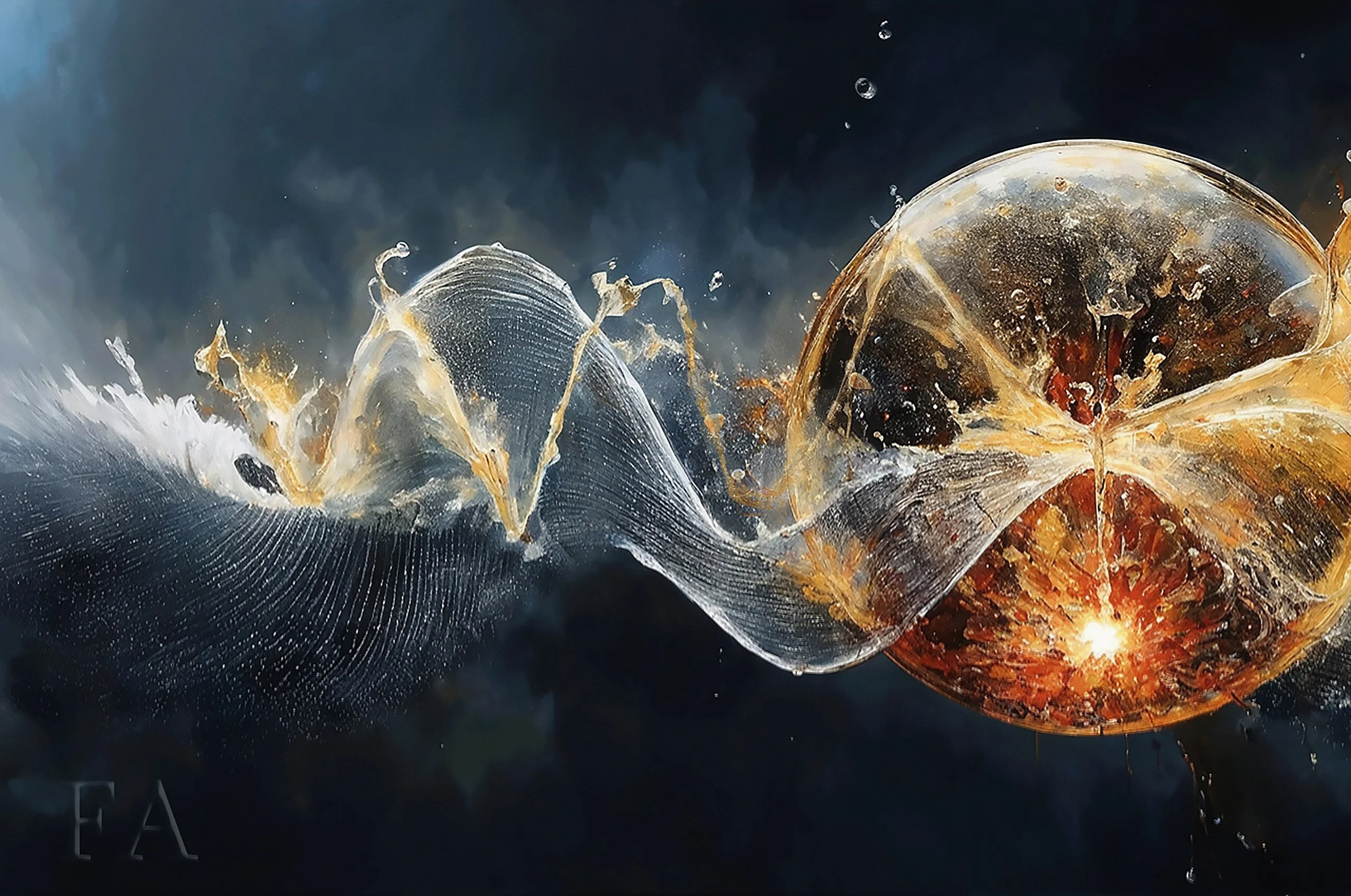
The painting on the cover — «Chronology» →
— Evgeny Fleysher
Artist and engineer. Author of WHY? and The Spiritual Alphabet, creator of the Art as Healing project. Paints works built on sacred geometry.
About the author and the method →