Ask not «what is painted» — ask why. «What» shows you the object. «Why» shows you the person who held the brush, and the age that looked through their eyes. Art is not about beauty. Beauty is a side effect. Art is the trace consciousness leaves of itself.
A person does not paint the object — they paint their own consciousness.
If that is true, then the whole history of painting is not a sequence of styles. It is a chronicle of how the human being changed inside. Walk it from the beginning and you will see not a museum but an X-ray of the soul, frame by frame.
From the cave wall to the temple dome
It begins in darkness. Lascaux, a bison on the rock, firelight breathing on the wall. Man paints what his life depends on: the beast, the hunt, strength. Consciousness is compressed into a single question — survive. And the painting is about exactly that: not decoration but incantation, an attempt to negotiate with a world stronger than you.
Millennia pass, and the gaze rises from the earth to the sky. The icon. No body, no shadow, no perspective — none is needed, because you are not meant to look with your eyes. The gold of the background is not paint; it is the absence of space and time, the eternity in which the holy face stands. Man is no longer surviving. He stands in the presence. His consciousness is occupied not with the beast but with God.
Man steps into the centre
Then comes the shift we call the Renaissance. Perspective appears, and it is not a technical trick. Perspective means the world has a centre again — and that centre is man. Leonardo measures the proportions of the body and finds in them the proportions of a cathedral. The sky has not vanished, but now it is looked at from below, with the confident gaze of someone who feels the divine within himself.
Let a man grow wealthy and he will stop painting gods. Holland, the seventeenth century: on the canvases a jug of milk, a window, a woman at a table, light on a copper basin. The sacred descends into the room. It turns out eternity lives in a milk jug too, if you look closely enough. Consciousness has learned to see holiness in the ordinary.
Consciousness changes first — then the hand. Style always comes second.
Light, dissolution and the return inward
And then the camera happens. Photography takes from painting its old job — the exact copying of the visible. And that is the best thing that could have happened to it. The freed artist turns from the object to perception. What matters to the Impressionist is not the cathedral but the light on the cathedral at seven in the morning and at noon — not the thing, but how consciousness lives it through time.
From there it is one step to the dismantling of form itself. Cézanne looks for the sphere and the cone beneath the apple. Cubism takes the object apart into facets and looks at it from everywhere at once — the way it is seen no longer by the eye but by the mind. And finally the object disappears altogether. Abstraction is painting that has dropped the object like a spent rocket stage. What remains are pure forces: colour, rhythm, tension. The artist is no longer painting the world but the direct speech of his inner state.
Trace the whole line: beast → God → man → thing → light → form → pure state. All that time the gaze was moving in one direction — inward. From what is outside me and stronger than me, to what is inside me and is me. For five centuries painting was learning to look not at the world but at the one who looks.
And here is my own why. If a painting has always been a cast of consciousness, then it can be made not as a reflection but as an instrument. Not «here is what I see» but «here is the state I want to bring you into». The geometry beneath the canvas — circles, axes, proportions — is exactly that tuning: form sets a frequency, and frequency changes the one who looks. The painting stops being a window and becomes a tuning fork.
That state is love. Everything else is only the frame around it.
This is why we paint. Not to repeat the visible — there is a camera for that. But to leave a trace of one’s consciousness precise enough to return, across centuries, across canvas, through another’s eyes, the state one was in. Art is a way of passing on not a picture but a quality of inner light. And as long as there is someone to look, that light does not go out.
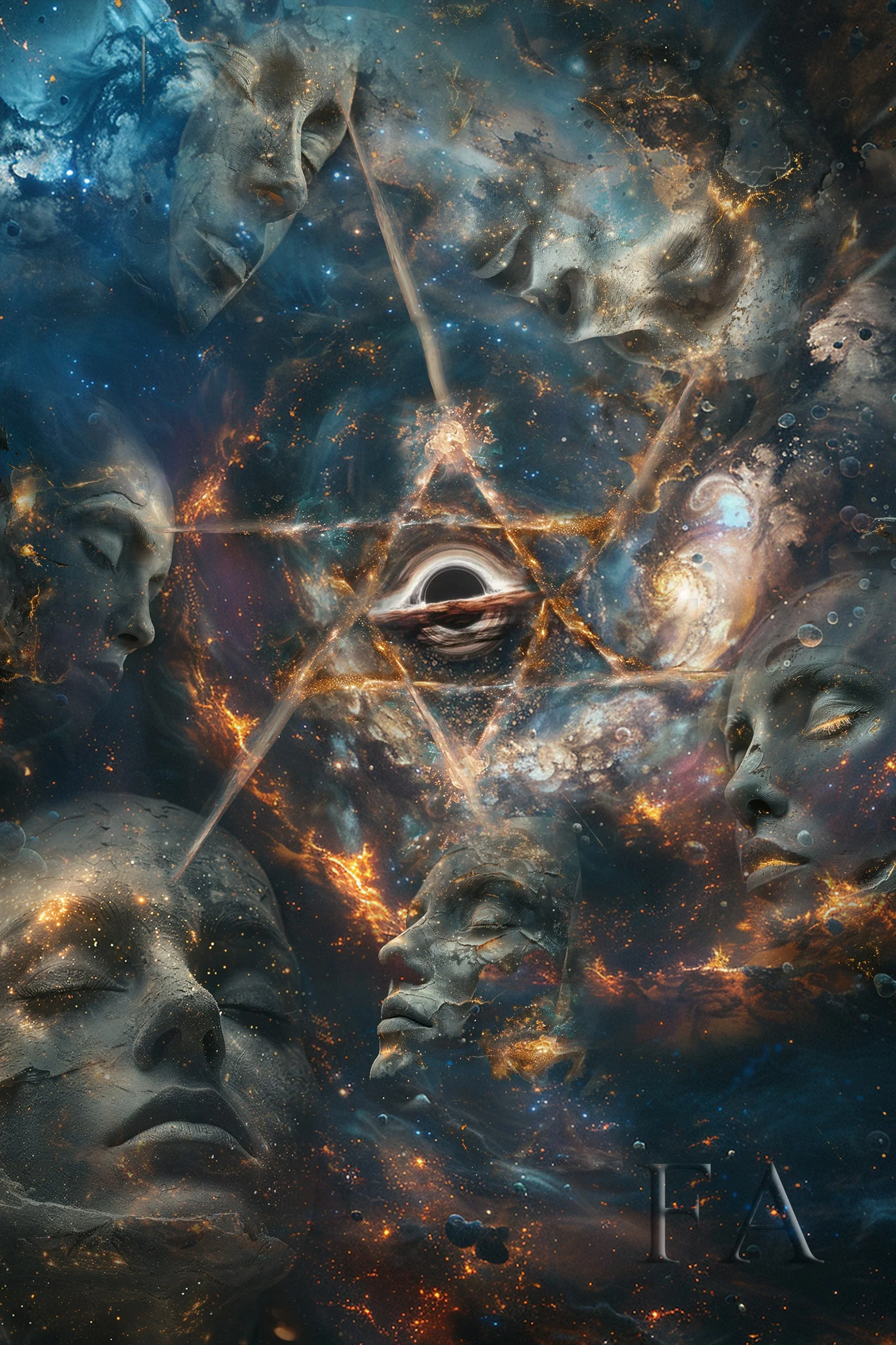
The painting on the cover — «The Gaze» →
— Evgeny Fleysher
Artist and engineer. Author of WHY? and The Spiritual Alphabet, creator of the Art as Healing project. Paints works built on sacred geometry.
About the author and the method →