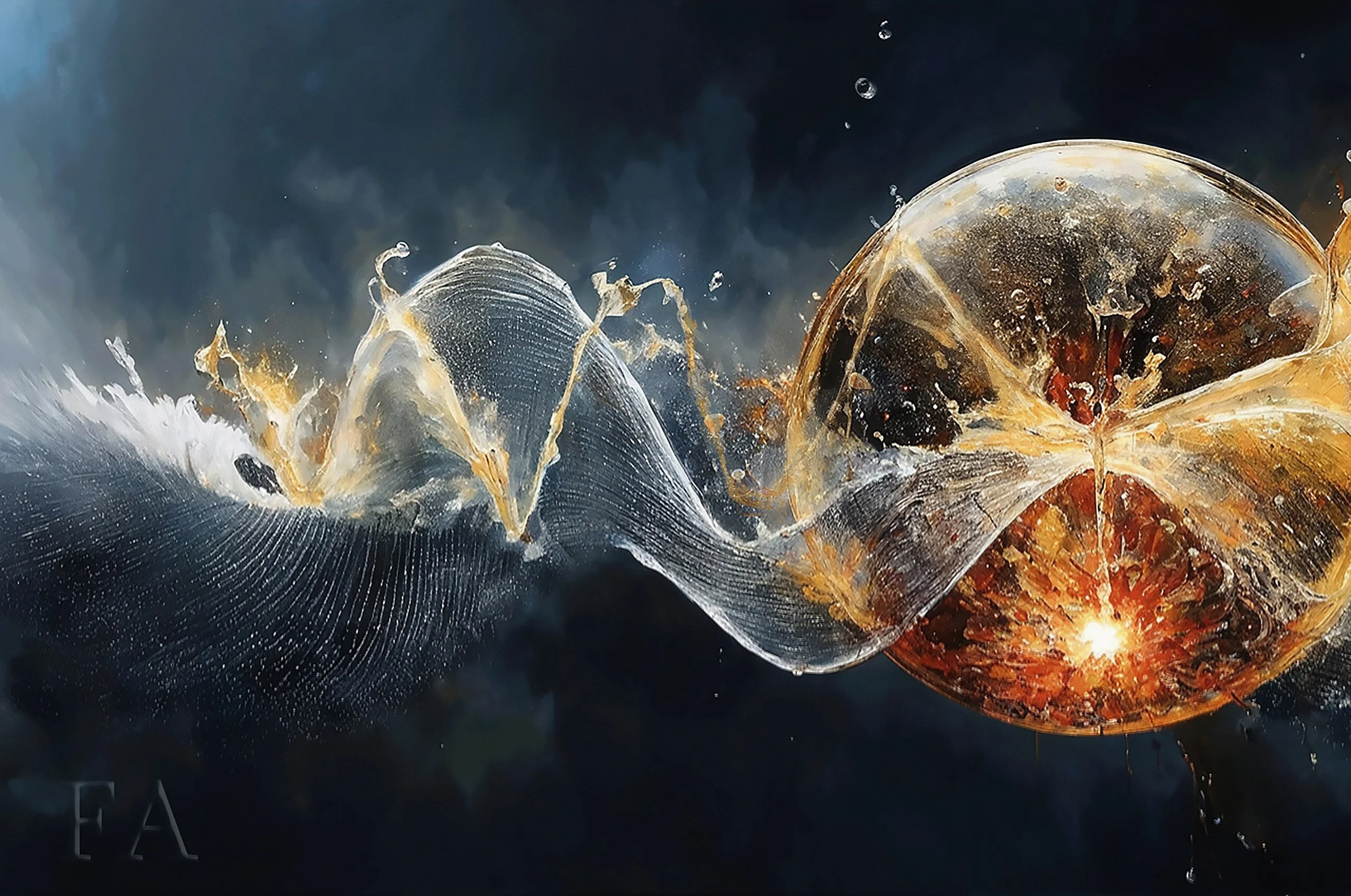
Chronology is a word spoken at the right time. A strange definition for a term we usually reserve for the order of dates in a textbook. But why «at the right time»? Because it is you who decides when to say that word. Forming a specific answer always takes time, and an answer is always a word or an action. Chronology is not a conveyor belt you are carried along. It is your ability to land in the moment.
Time is something people invented for the convenience of counting events. The clock on the wall shows fixed divisions — but the sun never rises the same way twice, no two falls of a ray on the same leaf of the same tree are ever identical, and even the hand of the clock never clicks over in exactly the same way: a mechanism that precise is impossible. Everything is relative — time included. Relative to what? To events. If no events happen, there is no time.
Time is relative to events. No events — no time.
Why time races and why it crawls
You will have noticed: sometimes time flies, sometimes it drags painfully. Follow the chain: perception depends on concentration, concentration on importance, importance on necessity, necessity on thinking — and thinking on how you respond to what you feel, and whether you understand what you feel at the moment you respond. The practical end of the chain is simple: when a person concentrates on what they do NOT want, time slows down. When they concentrate on what they do want — and do something towards it — time flies. «Happy people don’t watch the clock» is not poetry but an exact description: in a moment of happiness a person lives inside the event, inside sensation and response — and time dissolves for them.
The same chain gives an honest view of time management. From the standpoint of reaching goals it is a side effect, and it works only when you know precisely what you are spending your time on. You cannot work all the time — that way you will never become happy. Even if work seems to keep you in a state of happiness, that is more likely the sign of a reserve of strength that feels «endless» — and will certainly run out. There has not been one case in history of a person grinding through an entire life without the rebuild arriving. It always arrives.
Chronology is a word spoken in time.
Governing time from the present
Can time be governed? It can — by stepping out of identification with it and understanding the patterns of its movement. Any event contains a set of smaller events, and the pattern of those small inner events always shapes the outcome of the large one. That is what it means to see what will happen tomorrow, and why. But if you want to influence the outcome, do not concentrate on the process running right now — it is already known, and its end is already legible. Concentrate on what you want to reach: you need to see the final result in order to understand which intermediate processes it is made of — and how to set them.
One last thing — about scale. You can think about the same event at the scale of a dinner in a restaurant, of a lifetime, of several generations, of billions of years, of infinity — and each of these ways of thinking is nested inside events that themselves consist of events. Which is why predestination is not a verdict. It is the understanding of events in the context of other events — events we can rebuild in the present by means of our own thinking. The ribbon of dates belongs in the textbook. For a living person, chronology is the moment they found the resolve to say their word.
Predestination is events in the context of events — and you rebuild them in the present.
The work on the cover — «Chronology» →
— Evgeny Fleysher
Artist and engineer. Author of WHY? and The Spiritual Alphabet, creator of the Art as Healing project. Paints works built on sacred geometry.
About the author and the method →