Set two mirrors facing each other and you get an infinity of reflections. A corridor receding into the depth, thousands of copies, each slightly darker than the last. Impressive. But not one new face will ever appear in that corridor. A neural network is such a mirror, only vastly more complex: it reflects not one room but billions of paintings, photographs, sketches — everything humanity has managed to create and digitise. And it reflects with virtuosity. The only question is what we mean by the word “create”.
First, soberly — without panic and without rapture. A generative model is trained on a mass of already existing images. It does not look at the world — it looks at pictures of the world, that is, at other people’s gazes, already stopped once. Inside it there is no bison, no sunset, no face — there is statistics: how often one thing occurs beside another, which forms, colours and compositions keep company. When you ask it to “draw”, it does not draw — it computes the most probable image for your words, interpolating between what has already been. It does this astonishingly fast and astonishingly well — denying that would be foolish. But “fast” and “well” are the properties of an instrument, not of a source.
The machine combines what has been. The new is born not from combination — from a state.
The librarian who has read everything
Imagine a librarian who has read every book in the world. Every single one. He can answer any question, retell any plot, assemble out of a thousand read sentences a new one — smooth, precise, more like literature than literature itself. One thing he cannot do: his father never died, he never loved without an answer, never froze on a station platform, never held a newborn in his arms. He has nothing to write about. Everything he says will be a retelling of other people’s experience — brilliant, but a retelling.
The neural network is that librarian. An analyser of colossal power, but an analyser without feeling. It has no body — and so no pain, no cold, none of that tightening in the chest out of which a person one day walks to the canvas. It has no past that burns and no future it fears. It has no “why”. You can write a “why” into the prompt — but it will be your “why”, lent to it for the thirty seconds of generation.
In other words: art was never the production of images. The image is a trace. Art is the state the trace preserves. The artist carries onto the canvas not an object but the frequency he himself was on — and if in that moment he was alive, in love, torn open, concentrated, that frequency is written into the form the way sound is written into the groove of a record. A viewer a hundred years later runs his gaze along the groove — and hears. That is the whole mechanism of art. In the machine’s version of this chain, the first link is missing: it has nothing to record, because it is not in any state at all.
A neural network has no “why”. And without a “why” there is an image — but no art.
We have been here before
The cliché of the day: “AI will kill artists.” Turn it over and you will see we have been through this before, letter for letter. In the nineteenth century the camera appeared, and painters were told the same thing: why a portraitist, when there is a lens? Photography really did take painting’s old job away — the exact copying of the visible. And that turned out to be the best thing to happen to painting in centuries: released from the duty of repeating the object, it went inward. The Impressionists began painting not the cathedral but the light on the cathedral; Cézanne looked for the sphere and the cone beneath the apple; Cubism took the object apart into facets — until abstraction let go of the object entirely. Every time an instrument takes the craft part away from a human being, the human being is left with the part that cannot be handed to an instrument. It hurts — and it moves things forward.
So it is now. The neural network will take from the picture everything in the picture that was craft: stylisation, compilation, “make it pretty in the style of”. It is taking that already — and rightly so, because “pretty in the style of” never was art; it was a skill, and skill always ends up automated. What remains is what cannot be compiled: a living person at a specific moment, his state, his question to the world. Not “what is drawn” — why.
Instrument and source
That is why the argument “machine versus artist” is a false argument — an argument about who drives nails better, the hammer or the carpenter. The hammer drives them better. The carpenter knows where the house should stand. The real boundary runs not between human and machine but between instrument and source. The neural network is an instrument of genius: a library of all images at once, an assistant who in a minute will show you forty variants of a composition and spare you weeks of rough work. Use it. Refusing a library was always a sign of fear, not of strength.
But the source is not in it. Creation is not the assembly of the new out of the old; creation is when something enters the world that was not in it — a new scenario, not a rearrangement of previous ones. And it happens, as far as I can judge from my own experience at the canvas, from one state only — from love. Not from sentimentality, but from that fullness in which fear disappears and surplus appears: you have something to share. Fear copies and defends; calculation combines and optimises; only love creates. The machine has no access to that state — not because it is still weak, but because a state is not information. It cannot be downloaded; it can only be inhabited. For that you need a body that feels and a consciousness that asks “why”.
Ask yourself honestly: what are you afraid of when you look at a generated picture? Is it not that your own work was compilation — and the machine has simply shown it faster? Then thank it: like a developing bath, it has separated the craft in you from the source. Everything it can do, you no longer have to do. Everything it cannot do is your territory — and that territory is drawn today more clearly than ever.
The instrument answers “how”. Only the living answer “why”.
The machine will draw better and better — let it. The corridor between the mirrors will grow longer, the reflections cleaner. But a new face will appear in it only when a human being walks into the room — alive, feeling, loving. He is the thing the machine cannot do.
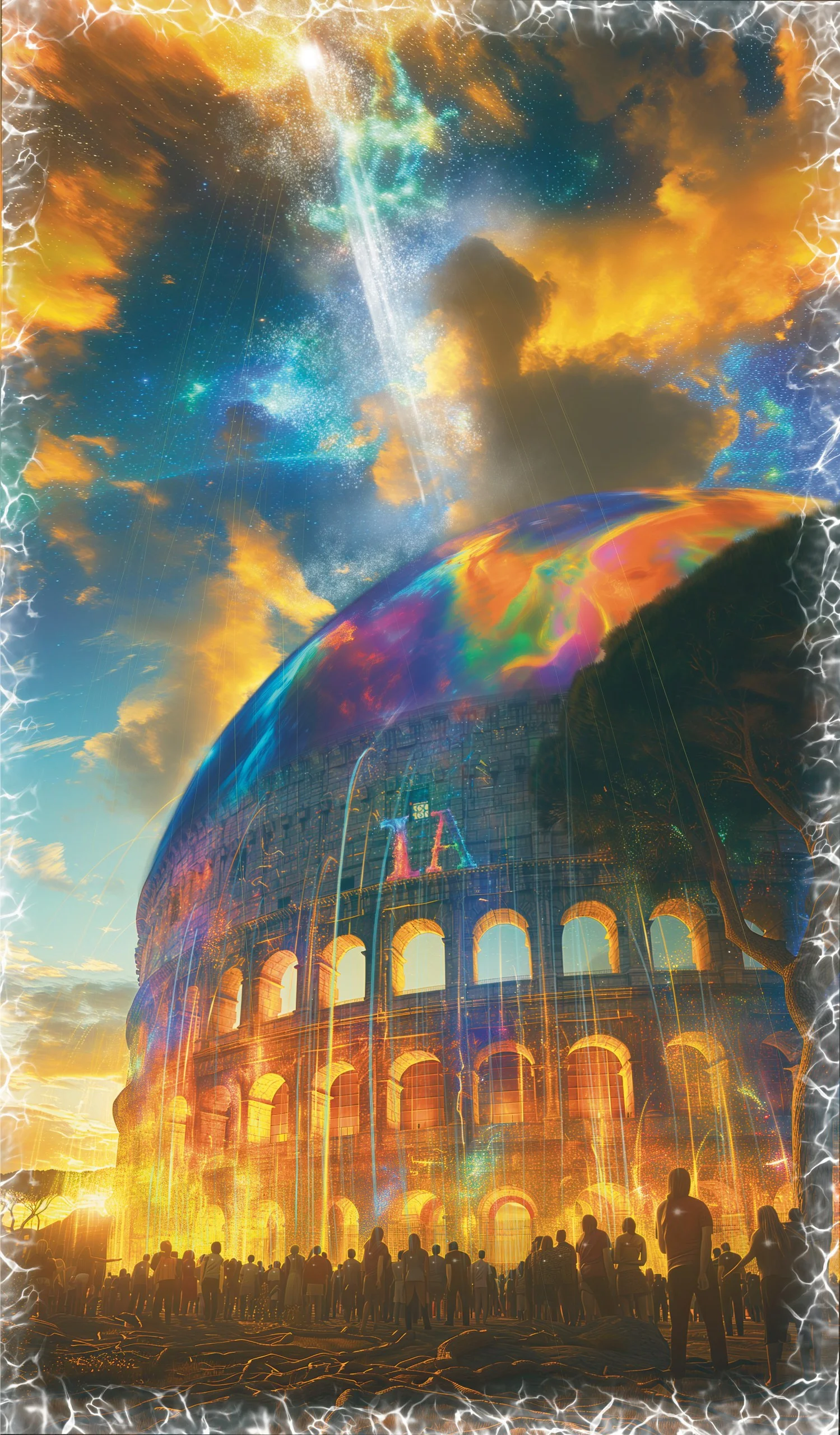
The work on the cover — “Artificial Intelligence” →
— Evgeny Fleysher
Artist and engineer. Author of WHY? and The Spiritual Alphabet, creator of the Art as Healing project. Paints works built on sacred geometry.
About the author and the method →