You stand in front of a white canvas with a single black stripe and feel the irritation rising. «I could do that.» Sound familiar? Here is the thing: irritation is not a verdict on the painting. It is a signal that you have asked it the wrong question. You asked «what is painted here» and «could I do the same». But the painting only answers a different question — «why was this made, and what state does it carry».
Most of the time, not understanding is a wrongly asked question — not the absence of an answer.
The difference is enormous. «What is painted» is a question about the object. It was the main question right up to the day the camera was invented. As long as painting was the only way to arrest the visible, mastery was measured by likeness: the more precisely a jug resembled a jug, the better the painter. But in 1839 the daguerreotype appeared, and within a generation photography had learned to copy the world faster and more accurately than any hand. Painting was relieved of its old job. That did not kill it — it set it free.
Where the object went
Follow the line and everything falls into place. The Impressionists no longer care about the cathedral as an object — Claude Monet paints the same Rouen Cathedral dozens of times, because what interests him is not the stone but the light on the stone at seven in the morning and at noon. Paul Cézanne looks beneath the apple and Mont Sainte-Victoire for simple bodies — sphere, cone, cylinder. Pablo Picasso and Georges Braque, in Cubism, take the object apart into facets and show it from several sides at once — the way the mind knows it, not the way the eye sees it. And in the 1910s Wassily Kandinsky takes the last step: he removes the object altogether. What remains is pure colour, rhythm, movement — that is, pure state.
In other words, painting dropped the object the way a rocket drops its first stage: not because the stage was bad, but because it had done its work. Impressionism, Cubism, abstraction — these are not whims and not decay. They are one consistent movement of the gaze in a single direction — from what is outside towards what is inside. And if you stand before an abstraction looking for the object, you are looking for the stage that was deliberately jettisoned.
The point of abstraction is the absence of the object. Remove the object — and what it existed for remains.
Duchamp, the urinal and the essential trick
Now for the case that infuriates people most — the readymade. In 1917 Marcel Duchamp took an ordinary factory urinal, signed it with the invented name «R. Mutt», titled it «Fountain» and submitted it to an exhibition. The scandal has held for a hundred years. And rightly so — that is exactly what Duchamp wanted. He was not claiming the urinal was beautiful. He was asking a question: what makes an object art in the first place — the hands of a master, or the gaze and decision of an artist? He moved art from the territory of «made beautifully» into the territory of «chosen and named». Gesture instead of craft. Ever since, to understand a readymade is to understand that what stands before you is not an object but an act.
A simple law of attention is at work here: you create what you look at. Duchamp turned the crowd’s attention onto a household thing at a new angle — and the thing changed, though the porcelain stayed the same. It was not the object that changed. It was the one looking. That is the mechanics of all conceptual art: the artist gives you not a picture but a lens through which, for a second, you see the world differently.
From there the road runs straight to Andy Warhol. His Campbell’s soup cans and repeated faces of Marilyn are neither laziness nor mockery. Warhol took the language of advertising and the supermarket — the print run, the repetition, the packaging — and made it a mirror of an age that was just learning to live among print runs and repetitions. He was not painting a can of soup. He was painting a society that had raised a can of soup into an icon. And the conceptualism of the 1960s — Joseph Kosuth with his «One and Three Chairs», where an actual chair stands beside its photograph and a dictionary definition of the word «chair» — asks directly: which of these is the real chair, and what do we even call reality? The idea becomes more important than the thing. This is no longer painting about the world; it is painting about how we think the world.
A working lens: three questions instead of one
Here is a tool you can use right in the gallery, in front of any work you don’t understand. Three questions instead of the one useless «is it beautiful or not».
First — context. When was this made, and against what? Art is almost always a reply in a conversation: the readymade argues with the cult of craft, Pop Art with the consumer society, abstraction with the rule of the object. Find out what the work is answering, and half of the confusion leaves by itself.
Second — gesture. What exactly did the artist do: paint, choose, repeat, erase, enlarge, put in the wrong place? Often the whole statement lives in the action, not in the image.
Third — state. What do you feel in the body, before words? Anxiety, silence, cold, warmth, emptiness? Mark Rothko placed the viewer in front of vast fields of colour not for decoration — people wept in front of his paintings without understanding why. Colour and form set a frequency, and a frequency changes the one who looks. That works without any explanatory label.
Don’t ask «what is this». Ask «why is this» — and «what is happening in me right now».
And a word of honesty about the boundary. Not every work is deep — contemporary art has its share of the empty, the speculative, the made for market and noise. But there is only one way to tell the empty from the genuine: ask the right question first. «It’s just daubing» and «it’s genius» are both lazy answers if you never asked «why». Snobbery and contempt are the same door, merely closed from different sides. Understanding begins when you stop defending yourself and let the work ask a question of you.
So next time, in front of a black stripe on white, don’t rush to laugh and don’t rush to worship. Ask: why did the artist remove everything except this stripe, and what is it doing to your attention right now? Answer that — and it will turn out that contemporary art was never talking about paint. It was talking about you.
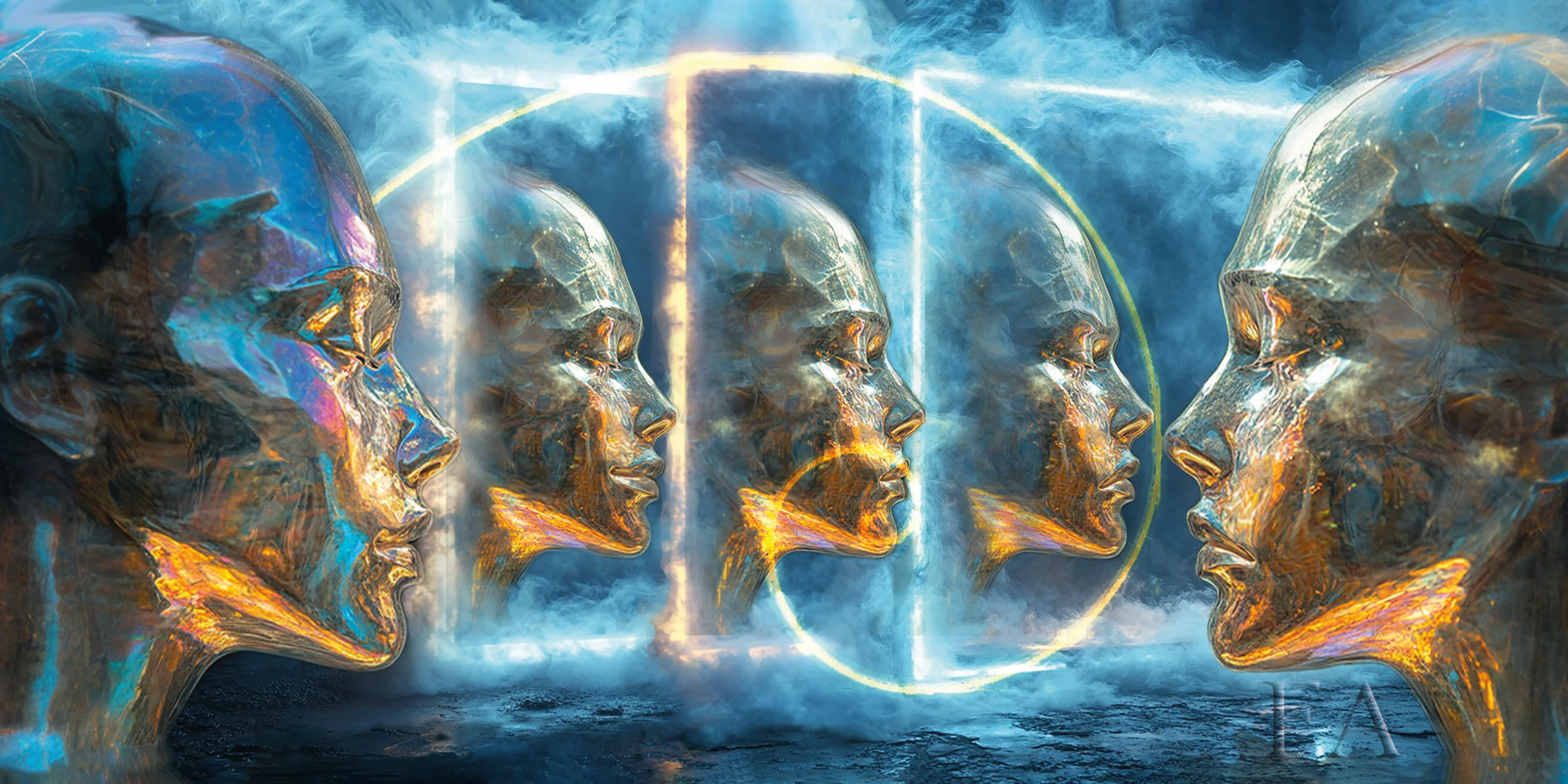
Cover work — “Illusion” →
— Evgeny Fleysher
Artist and engineer. Author of WHY? and The Spiritual Alphabet, creator of the Art as Healing project. Paints works built on sacred geometry.
About the author and the method →