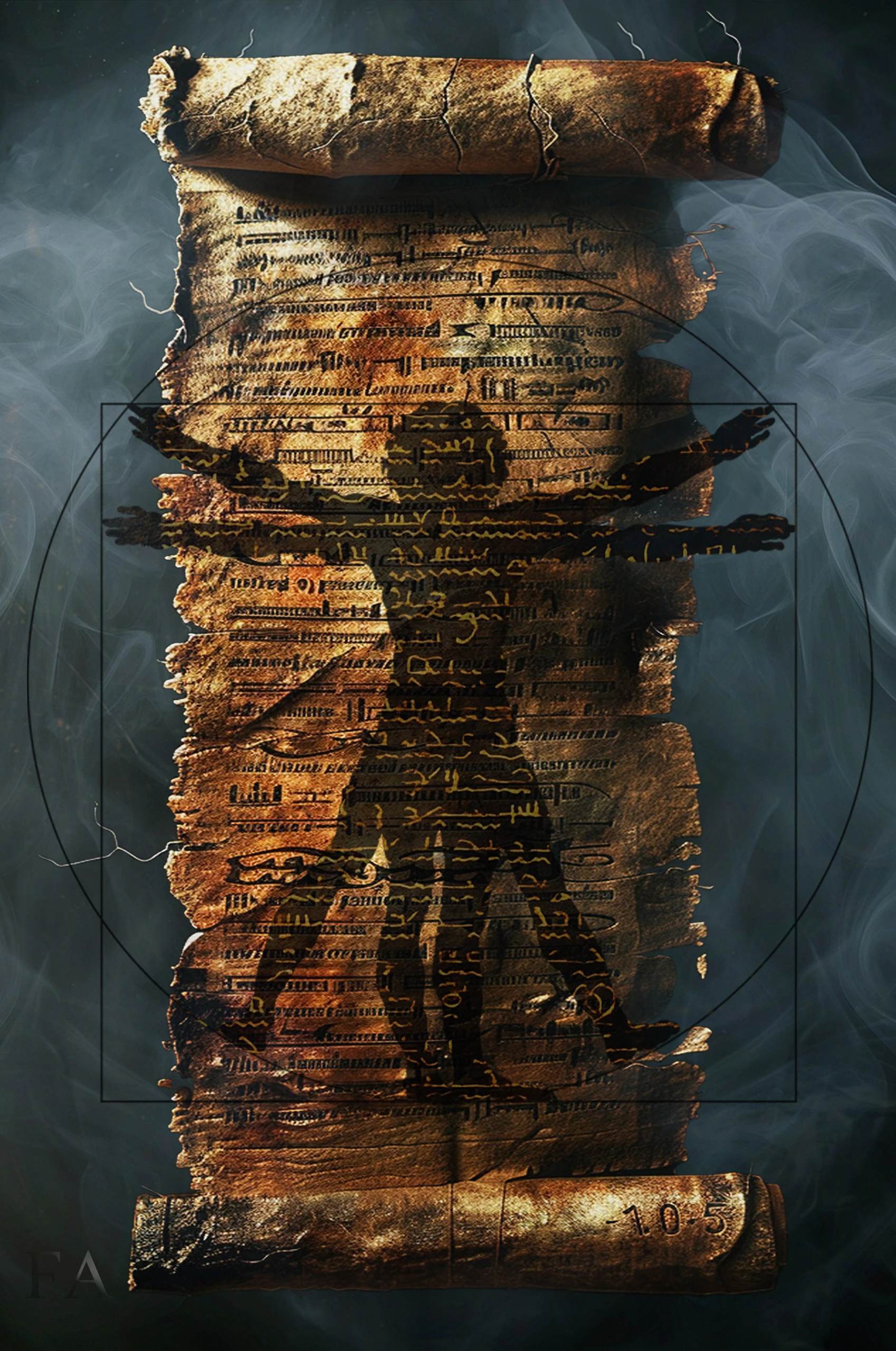
Surrealism is not the painting of dreams. It is the admission that the dream is more honest than the day. The prefix “sur” means exactly that — above: sur-realism, a reality laid over the one we agreed to call the only one. And here the interesting part begins, because “agreed” is the key word. The reality you are used to is not what is. It is what we have contracted to consider real.
Surrealism is the optics of the unconscious: what the brain hides and the soul knows.
All day long the mind works as a guard. It stands at the entrance and turns away everything that will not fit into “common sense”: the illogical, the shameful, the frightening, the impossible. It sorts the world into “can happen” and “doesn’t happen”. At night the guard goes off to sleep — and into the hall walk the ones he refused all day. That is how the dream appears: the dream where clocks flow, where you wear a stranger’s face, where you fly and it feels normal. The surrealist simply took what each of us sees with closed eyes and carried it onto the canvas with eyes open.
How the guard fell asleep
There is a date for this. Paris, 1924: André Breton writes the Manifesto of Surrealism. Breton was not only a poet — he had worked in psychiatry, had seen people whose guard had weakened, and had heard what a person says when control is released. And he drew a conclusion that still makes the head spin: what we call madness and raving is not a breakdown. It is the direct speech of what lives inside. The dream, for Breton, is not a distortion of reality but its unedited version.
From this came his method — automatism. To write and to draw without letting the mind interfere: the hand moves before the head has time to say “you can’t do that”. In other words, the same thing that happens to you in training on an empty stomach, when the body suddenly does something you did not expect of it, because reason had no time to prop up the crutch of habit. Automatism is a way of catching your real self before you comb yourself into shape for other people’s expectations. Breton believed that what comes out from under the hand in that moment is you — and everything else is make-up.
And here it is important not to confuse two things. Surrealism is not about inventing something stranger than the next man. Inventing strangeness is easy and empty. Surrealism is about removing the filter and seeing that the strange is already here, inside — you were simply keeping it under guard.
Four doors into one room
Every great surrealist opened this door in his own way. Salvador Dalí drove himself into the state between sleep and waking and brought back his melting clocks and burning deserts — he called it a method, but in essence it was fishing in his own unconscious. Dalí did not depict the impossible — he showed time the way a sleeper feels it: soft, sagging, without hands.
René Magritte came in from the other side — not through heat but through cold precision. He paints a pipe, an ordinary pipe, as neatly as in a textbook, and writes underneath: “This is not a pipe”. The viewer stumbles. What do you mean, not a pipe — there it is. And Magritte is calm: of course it is not a pipe — it is a picture of a pipe, paint on canvas; you will never smoke it. In one line he laid open the ground our whole perception stands on: we spend our lives confusing the thing with its image, the word with what it names. We live among labels and think that this is the world.
We take the map for the land — and walk the map all our lives.
Max Ernst invented techniques to take the initiative away from his own mind: he rubbed a pencil over the grain of wood and stared into the patterns that surfaced, the way a child stares into clouds and suddenly sees an animal. That, too, is automatism — letting chance speak first, then hearing sense in it. And earlier than any of them, before the word “surrealism” even existed, there was Giorgio de Chirico — his empty squares under shadows that run too long, where noon is as uneasy as a nightmare. De Chirico is the forerunner, the first to paint not a city but the state of a city in a dream, and to show the others that it could be done.
Why this matters to you
You could close the story here — beautiful eccentrics who painted strange pictures a century ago. But ask, as always, not “what is painted” but — why. Why would a person ever need to pull out into the open what he hides from himself?
Because the hidden does not disappear. It governs you from the dark. Everything the guard-mind refused entry by day knocks at the door of your dreams by night — and the rest of the time it quietly cuts the pattern of your life: your fears, your cravings, your unexplained “why did I do that again”. The outer world is a reflection of the inner one, and if the inner one holds a room you are afraid to look into, it will surface in your affairs anyway — only in a warped form. The surrealist does one simple, brave thing: he opens that room and switches on the light. Not to frighten — to see. Because what you look at directly stops steering you from behind your back.
That is why “the reality of the dream stands above common sense” is not a pose and not a provocation. Common sense is the majority’s agreement about what can happen. It is convenient; daily life rests on it; but it is blind to everything that did not fit into the contract. The dream negotiates nothing. The dream is the language in which the part of you that is older than words — and does not know how to lie — speaks to you. The mind says “I need to”. The dream, like the soul, says “I want to” — and in that “I want to” lies the whole truth about who you really are.
The dream is not a distortion of reality. It is reality with no guard at the door.
Surrealism never called you to live in delirium. It called you to stop fearing your own depth. Dalí, Magritte, Ernst, de Chirico are not a gallery of oddities but four mirrors, each turned inward. And when you stand before them and suddenly recognise in the melting clocks your own sense of time slipping away, and in the pipe that is “not a pipe” your habit of confusing the label with the life — the very thing happens that all of it was started for. You have met your real self. The one the brain kept out of the hall all day.
Cover work — “The Unknown” →
— Evgeny Fleysher
Artist and engineer. Author of WHY? and The Spiritual Alphabet, creator of the Art as Healing project. Paints works built on sacred geometry.
About the author and the method →