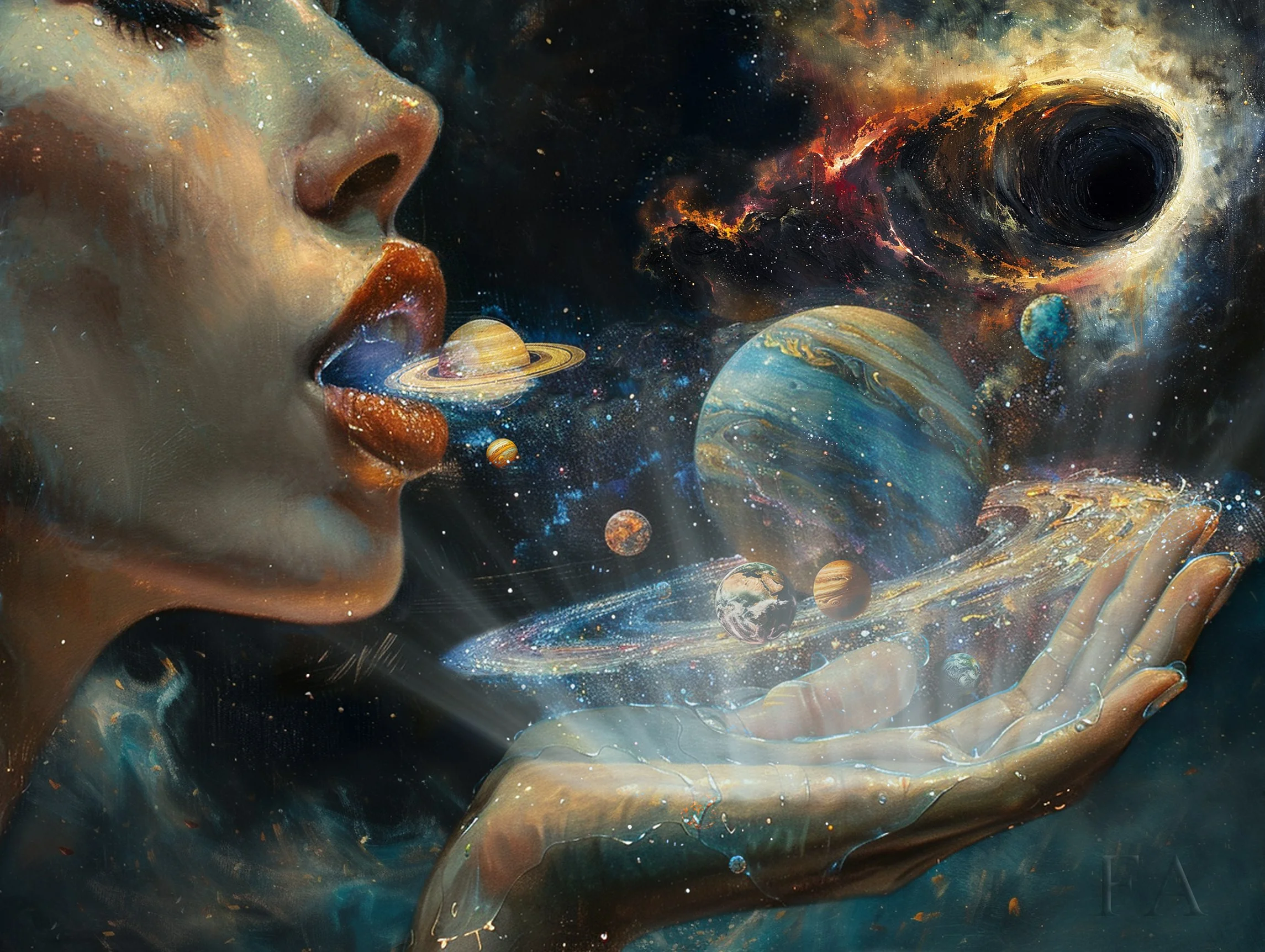
Emptiness is not what is left when everything has been taken away. Emptiness is what was there before anything appeared. The Western eye does not believe this: to it, an empty corner of a painting is unfinished work, a pause in conversation is an awkwardness to be plugged with words as fast as possible, a white field is a call to “add more”. The Japanese eye is built differently. To it, emptiness is a material — as workable as ink, paper and silk. Possibly the chief one.
In the West a canvas is filled. In the East it is left the right to breathe.
Japanese has a word for this — ma (間): a character of a gate with light showing in the opening. It is translated as “interval”, “pause”, “gap”, and every translation lies a little, because for us an interval is the service space between important things, while in the Japanese optic ma is the important thing; the pause does not serve the sound — the sound is arranged so that the pause becomes audible. In Noh theatre, ma is the actor’s stillness, which holds the hall more firmly than any gesture; in the tea ceremony, it is the spaces between movements, measured as strictly as the movements themselves. Not “the empty place in between”, but a quantity in its own right, with duration, tension and meaning.
The pause that speaks
Test it on yourself. Music is not the notes: the notes lie in any reference book. Music is the intervals between the notes — the rhythm — that is, emptiness cut to an exact meaning. Remove the pauses and what remains is noise, an acoustic porridge with no way in and no way out. The same in conversation: the weightiest word is the one before which the other person fell silent. Silence does not interrupt the content. Silence is the content — it only needs a contour for you to notice it. Japanese culture spent centuries building such contours.
In a traditional Japanese house there is the tokonoma — an alcove holding one scroll and one branch. Not ten scrolls, not a collection — one. The room is almost empty, and so the single thing sounds at full strength. It is like a restaurant: if the room roars with music, the lights blaze and the tables stand packed together, you will not taste even a great dish, because taste is a fine signal, and a fine signal needs silence around it. The Japanese interior does for the object what a good dining room does for the dish: it removes everything that interferes with perceiving.
The garden of Ryoan-ji in Kyoto is a rectangle of white gravel and fifteen stones. From whatever point of the veranda you look, you can see no more than fourteen: one is always hidden. The garden is built so that its main element is not the stones but the raked gravel between them; not what is shown but what is withheld. This is Zen in its pure form: truth is not told — room is cleared where it can happen to you. Monochrome ink painting works the same way: a few strokes of the brush and a vast untouched field of paper, which reads not as “nothing” but as mist, water, air, distance. The empty place is not silent. It works like an unasked question you nevertheless begin to answer.
Emptiness is not absence. Emptiness is the presence of possibility.
So is it enough to leave the sheet white, and the art is done? No. Emptiness works only next to absolutely exact form, as a pause works only next to an exact note. One stone placed carelessly — and the garden becomes waste ground. One stroke of the brush too many — and the mist becomes dirt. The less that is said, the more each word costs; emptiness does not forgive approximation — in that lies its strictness and its price.
The wave and the beauty of the imperfect
Now take the most famous Japanese image of all — Hokusai’s “The Great Wave off Kanagawa”, a sheet from the series “Thirty-six Views of Mount Fuji”, early 1830s. Ukiyo-e, “pictures of the floating world”, were mass prints: cheap, issued in editions, for the townspeople of Edo. Look at how the sheet is built. The wave rears up on the left and takes almost the whole sky, the boats plunge into its trough, and Fuji — the sacred mountain the entire series was made for — stands tiny, far away, in a window of emptiness between the crests. The asymmetry here is not carelessness but calculation: the eye accelerates along the curve of the wave as along a spiral and falls into the quiet centre. Chaos at the edges — stillness in the middle. The composition performs on the viewer the very thing it speaks about.
Beside ma stands a second word — wabi-sabi: the beauty of the incomplete, the imperfect and the passing. A cup with a crack, a plank washed by the rains to silver, cherry blossom prized precisely because in a week it will be over. Transience here is not sadness but a setting: blossom cannot be postponed until later; it can only be caught — which means the only point where beauty is available is now. The Western classical tradition sought perfection — the finished form to which nothing can be added. Wabi-sabi sees a dead end in such a form: the finished is closed; there is no way into it. In the incomplete a gap remains — the same emptiness, only in time: the thing is still becoming, and you complete it with yourself. The saying that “perfection has no limit” Japan turns inside out: there is a limit, and it is dead; only the unfinished is alive.
Why leave it empty
When Japan opened to the world in the middle of the nineteenth century and ukiyo-e sheets poured into Europe — sometimes simply as wrapping paper for porcelain — Western painting was shaken. Monet collected Japanese prints by the dozen; Van Gogh copied sheets by Hiroshige in oil. The Impressionists took from Japan the cropped edge of the frame, the flat patch of colour, the bold asymmetry — in essence, permission not to fill. By then the camera was already taking from painting the duty of copying the visible, and the Japanese print suggested what to do next: not the document but the state.
The main question remains — why. Why does a culture train, for centuries, the ability not to fill? Because emptiness is a resource, not a loss. A physicist will say: a vacuum is not “nothing” but a field saturated with potential. An artist will say it more simply: the unfilled place on the sheet is the only place where the viewer can stand. Fill everything — and you have informed. Leave emptiness — and you have invited. Attention creates: what a person looks at begins to exist for him — and the Japanese master builds not an image but a channel for another person’s attention. Water will find its own form, if you leave it somewhere to flow.
A message ends where the words end. An invitation only begins there.
So “emptiness as a method” is an inexact phrase — let it stand in the title as evidence of the Western gaze. A method is something done to the material. Ma is something done to the viewer: he is given back his own silence and allowed to stand in it for a while. Ask not “what is depicted here” but “why is nothing depicted here” — and Japanese art will answer: so that you become audible.
The work on the cover — “Silence as the Language of God” →
— Evgeny Fleysher
Artist and engineer. Author of WHY? and The Spiritual Alphabet, creator of the Art as Healing project. Paints works built on sacred geometry.
About the author and the method →