There is a painting everyone has seen, even without knowing the painter’s name: a man stands on a rock with his back to the viewer, looking out over a sea of fog. That is Caspar David Friedrich, “Wanderer above the Sea of Fog”. He invented a device that still works without fail: place a small human figure before something vast — sea, mountains, sky — and turn it away from us, so that we look not at it but with it. Friedrich is close to me because he made the canvas a threshold: a place where a person meets what is greater than they are.
He did not paint landscapes. He painted the state of a person before the infinite — the silence in which it becomes clear how small you are and how vast the world is.
What he saw
Friedrich saw the power of a simple move: a figure seen from behind stops being “a stranger in a painting” and becomes you. You take its place, step to the edge of the rock and look into the fog through its eyes. He set a human being before the eternal — and in that meeting the sublime was born: not fear and not rapture, but a quiet, enormous sense of the presence of something greater.
And he was right about the main thing: art can be a threshold, not a picture. Not “look at this view” but “stand here and feel”. Here he and I stand on the same ground. My works are built as thresholds too — I place you before a portal not so that you admire it, but so that you enter.
Where his model is not complete for me
But in Friedrich the person stands before the infinite as before something external and foreign. The sea of fog, the mountains, God — all of it is outside, vast and separate, while the human being is small and filled with quiet sorrow, a longing for the unreachable. His sublime is tinted with grief: you are forever on this side, and the eternal is on the other.
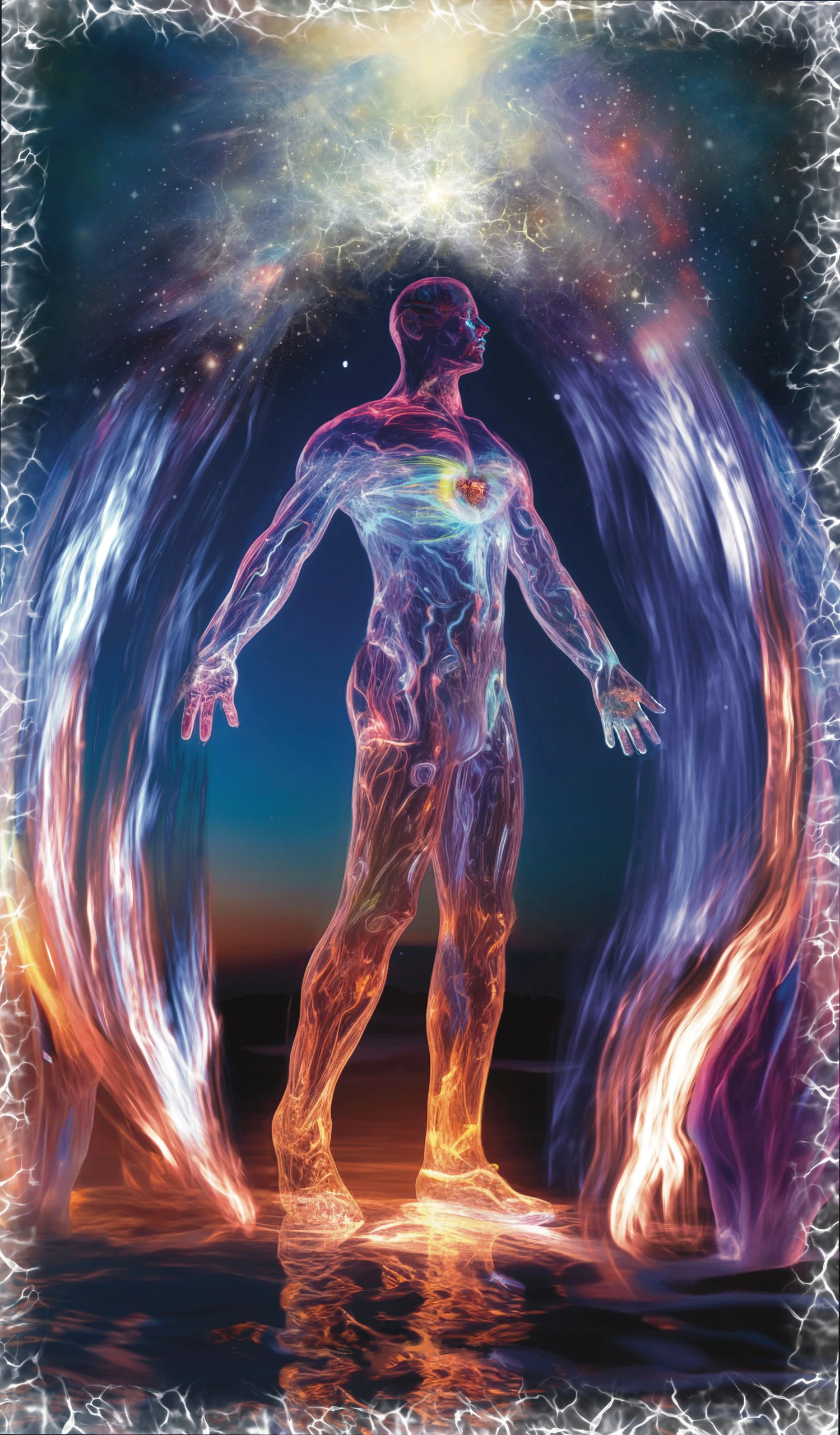
I am not correcting him — it was an honest Romantic truth, and it is painted with genius. There is no ideal model, and his would not have become mine even if we matched in every fog. My map simply turns the scene around. For me the infinite is not outside but within: the spiritual world comes first, and you look at it not as a small wanderer facing a foreign expanse, but as the one from whom that expanse is born. Friedrich sets a person before the eternal and leaves them longing for it. I set a person before a portal and say: it is not over there, it is yours — enter. In him the infinite calls up the sorrow of separation. In me — the joy of creation.
What this means for you
Honestly, with no promises: a view on a canvas will not grant you enlightenment and will not heal anything. I am not selling “spiritual experience in a frame”.
But you know Friedrich’s device from your own life. Sometimes it is enough to stand before something large — the sea, an open plain, the night sky — and the petty falls away, while silence and scale come through inside. A good work knows how to build such a threshold at home, on a wall. Not an answer and not an escape — a point at which you stand for a minute before the great and remember that you are part of it, not a guest.
And still
Friedrich turned a man with his back to us and his face to the eternal — and taught painting to be a threshold, not a window onto someone else’s landscape. It was a quiet revolution.
I suggest one turn further: to stand before the infinite not as before something unreachable outside, but as before what lives in you. Find with your eyes the largest thing near you and stand before it a while. Friedrich showed how that sobers and lifts. I will only add: what you are standing before is not foreign. It is you, turned outward.
The work behind this essay — “Belief as an Instrument of Creation” →
— Evgeny Fleysher
Artist and engineer. Author of WHY? and The Spiritual Alphabet, creator of the Art as Healing project. Paints works built on sacred geometry.
About the author and the method →