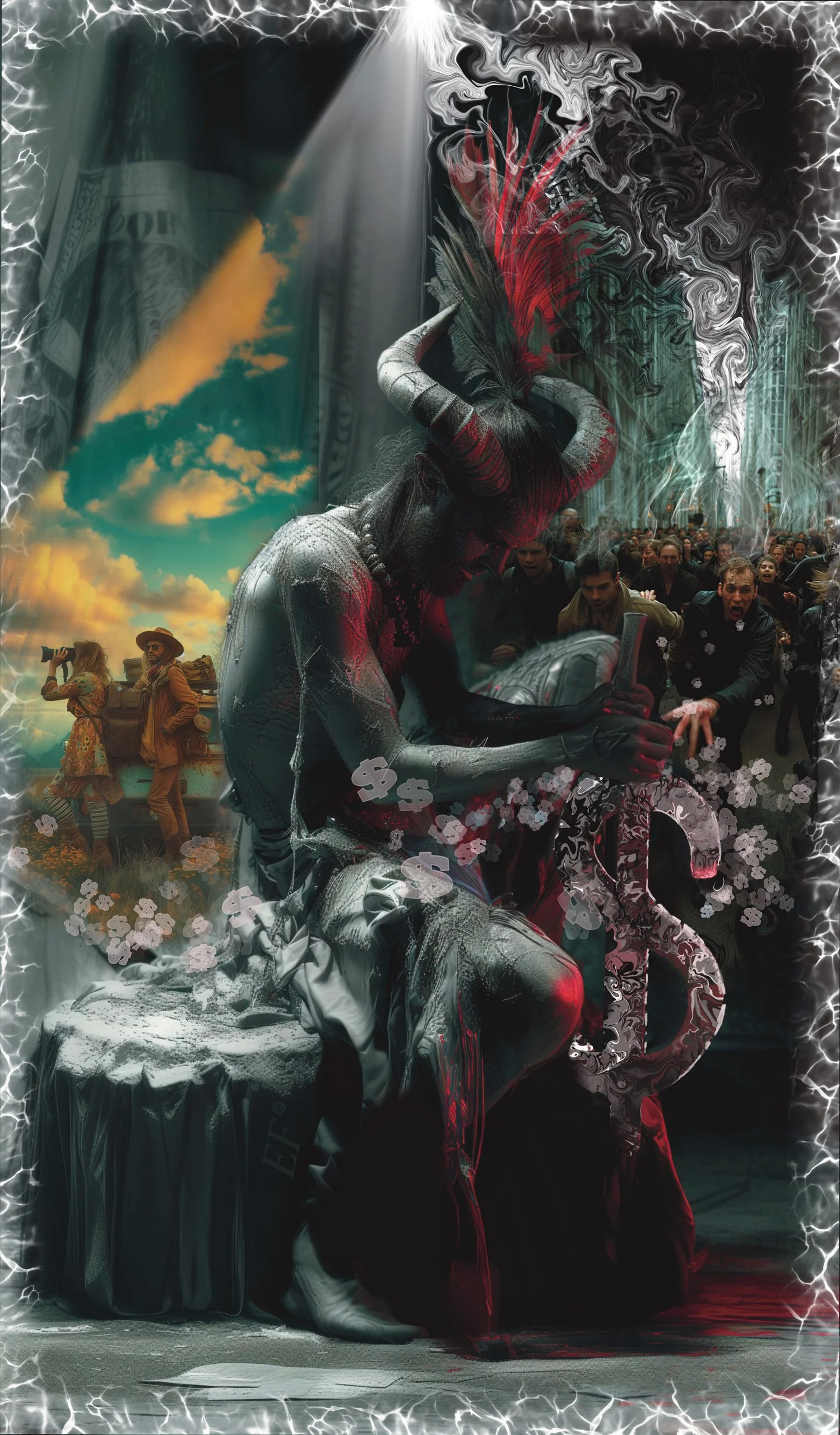
Price is not a property of a painting. It is a property of agreement. Don’t ask «how much is it worth» — ask who agreed with whom for that number to appear on the label. The canvas is silent. The number is spoken on its behalf — by dealers, auctioneers, curators, heirs, and whoever raised the paddle last. The painting hangs motionless on the wall, while around it goes on a kind of work that is almost never counted as painting: the market assembles, grain by grain, a collective «yes».
Price measures not the amount of value in a work but the amount of agreement around it.
Which is why the question «why do some paintings sell for millions while others sell for nothing» is honest but aimed at the wrong place. It sounds as if a treasure were hidden inside the canvas and our task were merely to appraise it more precisely. There is no treasure. There is paint, stretched linen and the trace of a hand. Everything else is drawn in around it by people. Let us take this mechanism apart plainly, without reverence — and then see what it actually measures.
The mechanics of price, exactly as they are
First, provenance — the history of ownership. The market pays not only for the image but for the chain of hands it has passed through: the cleaner and more distinguished the lineage, the calmer the buyer. Provenance closes two fears at once — that the work is a fake, and that it was acquired dishonestly. A painting without papers and a painting from a famous collection may come from the same brush, yet they will cost differently, because the second already has other people’s trust dissolved in it. You are paying for the fact that others believed in it before you.
Second, rarity. Supply is finite. When an artist dies, the number of his canvases will never grow again, and every one that remains becomes the last of its kind. Painting, unlike the printing press, cannot run another edition. Hence the simple arithmetic of scarcity: a fixed stock, rising demand — and the price climbs on its own, without a single new brushstroke.
Third, the name and the myth. We say «they bought a Van Gogh» as though a person were being bought, not a picture. And that is closer to the truth than it seems. The market trades not so much in the image as in the story around it: the biography, the legend, the recognisable silhouette of a signature. A name is a myth in packaging, and the tighter the packaging, the higher the bidding goes. That is why the signature in the corner sometimes weighs more than everything painted above it.
Fourth, institutions. A museum, a major gallery, a serious exhibition, a catalogue. These are the authorities that tell the market: look here, this matters. Institutional attention works like an amplifier — it adds no paint to the canvas, but it adds confidence to those who look at it. And confidence is what is being paid for in the end.
Attention is a currency. Whatever everyone is looking at is what appreciates.
And fifth, the subtlest of all — the author’s death as capital. While an artist is alive, he is a danger to his own price: he keeps painting, enlarges the supply, changes his manner, can devalue the old with the new. Death closes the account. The legacy becomes a finite set, the myth a completed story with a beginning and an end, and the market at last receives what it loves most — certainty. Hence the bitter truth of the auction room: posthumous fame often pays more generously than fame in life. Not because the world is cruel, but because price is a mechanism, and a mechanism needs things to stop before it can measure them.
What all of this actually measures
Put the five factors together — provenance, rarity, name, institutions, death — and you will see that not one of them is inside the painting. They are all outside. They are a layer of agreement grown over the canvas the way scale grows on the wall of a kettle: the longer attention has boiled, the thicker the layer. Price measures the thickness of that layer. Nothing more.
This is where a different lens switches on. Price is coarse matter — an excess potential accumulated around an object, like charge on the plate of a capacitor. It is real, it is visible, it can be weighed in figures — yet it is secondary, because matter is always secondary to whatever produced it. First there was the state of the one who painted. Then the state of those who looked and passed it on. And only at the very end, like a precipitate, does the number fall out onto the label. The number is the shadow of a process — and we have grown used to taking the shadow for the body.
Put differently: price relates to value roughly as temperature relates to warmth. The thermometer honestly shows its degrees, but warmth is movement, not a figure on a scale. You can heat a room and feel no warmth if you are alone in it and cold inside. So it is with a painting: the million under the hammer is the degrees of agreement, while the warmth is the state for which someone once picked up a brush at all. One is measurable and can be sold. The other is not — and so it never makes it into the reports.
Price is the shadow of value. A shadow can be enormous, but it is not what keeps you warm.
Hence the paradox this whole essay was written for: real value and price are not the same thing, and to confuse them is to stare at the thermometer instead of the fire. A work that costs a fortune and a work given away for nothing can carry the same state of the artist. The difference between them lies not in the canvas but in how much agreement has managed to build up outside it. Lascaux was never for sale. An icon was not priced in money — it stood outside the bidding, because no one looked at it with a buyer’s eyes. The seventeenth-century Dutch painted a jug of milk and a copper basin not for auction, but because the sacred had come down into their room. Price arrived later, by other hands, and grew over the top.
Does this mean the market lies? No. The market is precise — it honestly measures exactly what it knows how to measure: agreement, trust, scarcity, myth. The mistake is ours, when we take its readings for a verdict on value. The market does not know what happened inside a person while he painted. It only knows what is happening around the work now. These are different things, and every time we glue them together we lose the one that matters.
So at the end, ask not «how much does it cost» but why this price arose at all — what it wanted to show you. And you will see: it shows not the painting but us. Our fear of being wrong, our hunger to own what everyone believes in, our need to turn a state into a figure so that it can be possessed. All this time the painting hangs motionless and keeps what is its own — the warmth that was put into it. The millions make their noise outside, around the frame, and have no access to what is within.
A price can be owned. Value can only be resonated with.
Cover work — «Money» →
— Evgeny Fleysher
Artist and engineer. Author of WHY? and The Spiritual Alphabet, creator of the Art as Healing project. Paints works built on sacred geometry.
About the author and the method →