Set two canvases from the same decade side by side. In 1872, Claude Monet paints sunrise over the harbour of Le Havre — «Impression», the picture that named an entire movement: there is no story in it, because light is the story. In 1873, Repin finishes «Barge Haulers on the Volga» — and there are eleven fates in it, eleven biographies, and you want to ask every face: who are you, how did you end up here, what will become of you? One century, one paint, one sun. But the French picture is the verb «to see». The Russian one is the verb «to live».
This is not a question of talent, nor of schooling. It is a question of where attention is directed — and attention is always directed at what a culture holds to be most important. For France, painting was a science of the visible: colour, air, the vibration of light on water. For Russia, the visible was only ever a shell with meaning standing behind it — which is to say, a word. So the question «why is Russian painting so literary» really sounds different: why does the Russian gaze not know how to stop at the surface?
The French canvas asks: what does this look like? The Russian one asks: why did this happen?
The icon: an image you read
Begin at the root. Until the eighteenth century, Russian painting is the icon, and an icon is not a picture. A picture is looked at; an icon is read. It has no illusion of depth, no light source, no shadow, because it depicts not what the eye sees but what is true in meaning. Reverse perspective turns the space outward: the lines converge not behind the image but in front of it, in you — you are not looking at the image; the image is looking at you. The gold of the background is not a colour but the absence of time. Icon painting was called theology in colours for good reason: here the image carries word and meaning, and the form is only a carrier, as paper is to a letter.
In other words, the Russian eye spent several centuries training on a single exercise: through the image — to the meaning. It works like a road sign: you do not admire the circle or judge the shade of red — you instantly read «stop». When European painting arrived in Russia in the eighteenth century, with oil, perspective and chiaroscuro, the technique changed but the habit remained. The hand learned to paint in the European way. The eye went on reading in Russian.
A novel on a stretcher
Now watch what happens in the nineteenth century. In 1863, fourteen graduates of the Academy of Arts, led by Kramskoy, refuse to paint the competition picture on an assigned mythological subject and walk out — history remembers it as the «revolt of the fourteen». In 1870, the Society for Travelling Art Exhibitions — the Peredvizhniki — is born. Now lay the dates over each other: Tolstoy has just finished «War and Peace»; Dostoevsky is writing his great novels. Painting and literature are not merely neighbours — they breathe the same air and do one job with two hands. Perov paints Dostoevsky’s portrait, Kramskoy paints Tolstoy’s, and these are not society commissions but a call between workshops: word and paint recognising each other as kin.
And the Peredvizhniki pictures themselves are built like prose. They have an exposition, a conflict and a resolution carried beyond the frame. Repin’s «They Did Not Expect Him» is an entire novel compressed into one second: an exile walks into the room, and from the faces — mother, wife, children — you read everything that came before and guess at everything that will come after. Surikov’s «Boyarynya Morozova» is a historical tragedy in which the crowd is not a backdrop but a chorus, and every face is a separate chapter. Perov’s «Troika» is a social essay about children hauling an ice-crusted barrel of water through the frost. These pictures do not show — they tell, and therefore they demand time, like a text: you cannot see them in a second; you can only read them.
And when Kramskoy paints «Christ in the Wilderness», he poses in paint the same question Dostoevsky works out in words: what is a man to do when the choice lies between himself and the truth. It is not an illustration to the Gospel. It is a question of conscience that simply has no other form than a figure seated on a stone with clasped hands.
Conscience as a lens
It is customary to see a weakness here — and a weakness was indeed seen. In those same years Paris carries out a revolution of vision: the first Impressionist exhibition is 1874, four years after the Society was founded. The French take light apart into frequencies, like physicists, and in pure optics the Russian school genuinely lags. But here is the paradox: that lag is the continuation of a choice, not the absence of one. It is like a window: you cannot examine the glass and what lies beyond it at the same time. The French chose the glass — and discovered how it refracts light. The Russians chose what lies beyond the glass — the human being in his state, and the question of why all this is happening to him.
Impressionism is painting of the eye. The Peredvizhniki are painting of the conscience.
Attention creates: you build what you look at, and a culture does the same. French painting, looking at light, arrived at pure form and gave the world a new way of seeing. Russian painting, looking at conscience, produced the picture-as-question — a canvas before which you are not an observer but a participant, because the question is addressed to you personally: would you have stepped out of the crowd? would you have kept silent? Dostoevsky works on his reader in exactly the same way. So the «literariness» of Russian painting is not a borrowed device but a shared origin: both the novel and the canvas grew out of the icon — out of an image that carries a word and is turned towards you, rather than simply hanging in front of you.
So do not ask a Russian picture how the light falls. It will answer, but reluctantly. Ask it why — why this man has returned, why this woman raises two fingers above the crowd, why these children are hauling a barrel — and it will unfold like a novel. Russian painting is literary because, for the Russian gaze, the image was never the final station: it was always a door — to meaning, to conscience, to a state. And the state to which all these questions finally lead has been the same in every century.
Light can be painted. Conscience can only be asked. The Russian canvas is a question asked with love.
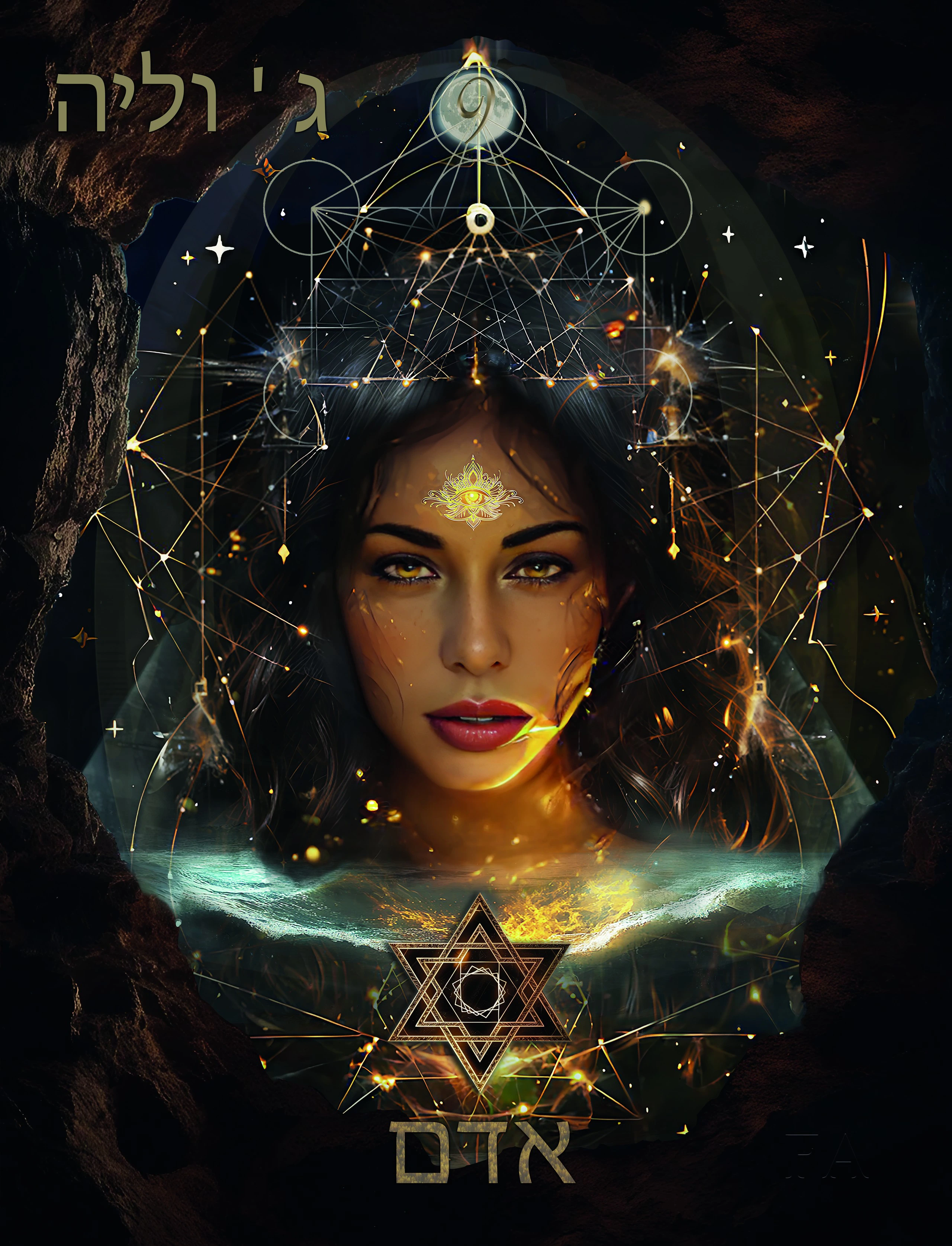
Cover work — «Julia» →
— Evgeny Fleysher
Artist and engineer. Author of WHY? and The Spiritual Alphabet, creator of the Art as Healing project. Paints works built on sacred geometry.
About the author and the method →