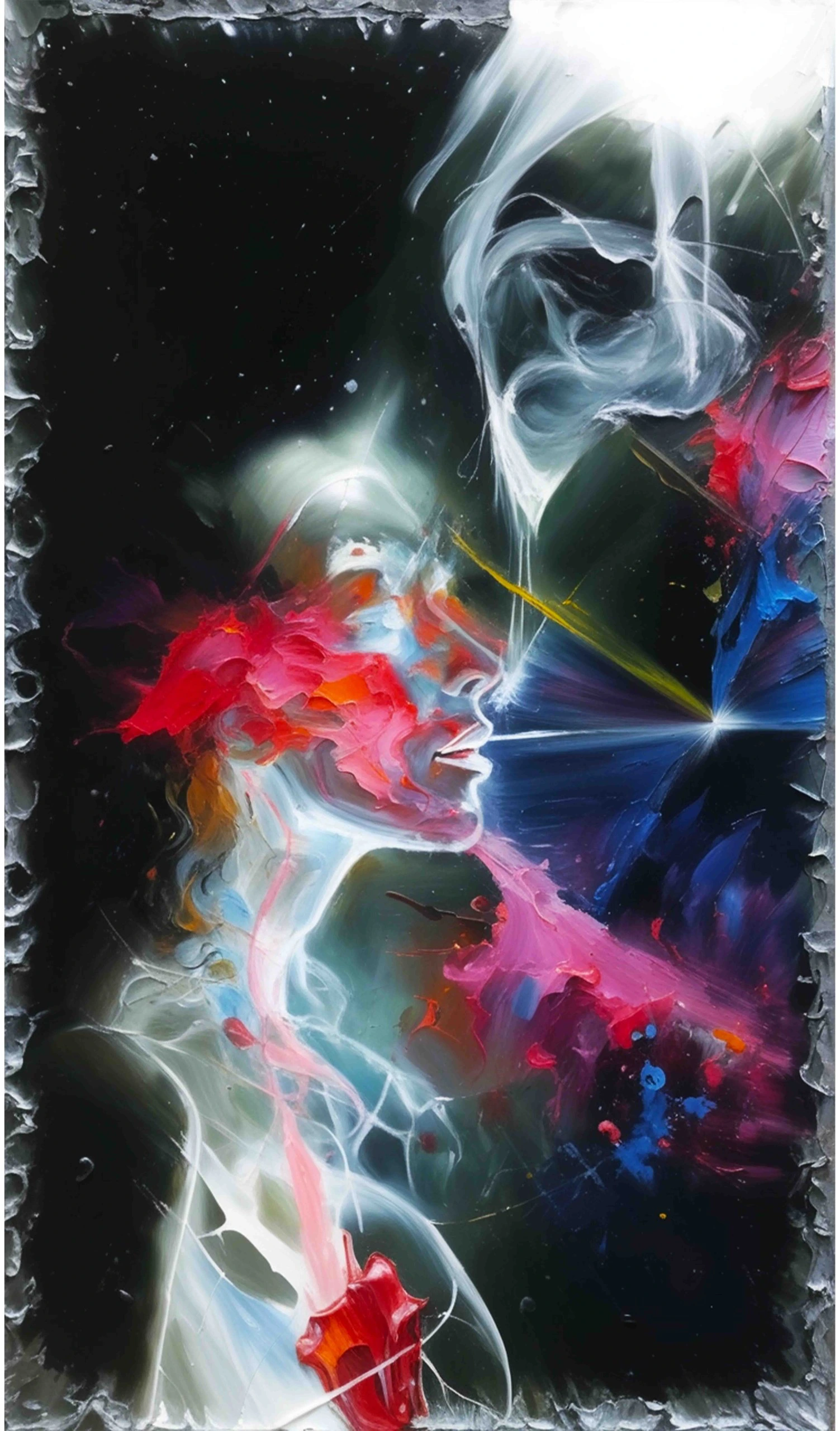
«Evgeny, an honest question, no trick in it. A baker produces bread, an engineer produces a bridge, a programmer produces code, and the use of each is obvious. But an artist? You cannot eat a painting, you cannot ride it anywhere, it does nothing — it hangs. What is art for, if it produces nothing?» — from a reader’s letter
A good question — because it is honest. And it deserves an honest answer, not the usual mumbled formula about «spirituality» and «beauty» that has never convinced anyone. So let me start by picking a quarrel with the question itself: hidden inside it is a claim that looks self-evident, and the self-evident is worth checking. The claim is this: to produce means to produce things. Objects you can weigh, load and sell. Everything else is not production but decoration, a dessert after the real meal, an optional line in the budget. Well — that claim is false, and to see it you do not need to be an artist. You only need to look closely at the bread itself.
What the baker actually produces
Take any useful thing and ask it «what for» — not once, but all the way down, until the questions run out. Bread is not needed for its own sake: it is needed so that hunger leaves and satiety arrives — that is, so that a person’s state changes. A bridge is not needed for its own sake: it is needed so that you reach the place where someone is waiting for you — so that separation gives way to reunion, and reunion is a state too. Medicine exists for the sake of health, a house for the sake of the feeling «I am protected», money for the sake of the feeling of freedom — and notice: however many links the chain has, the last link is always the same. Not a thing. A state.
A thing is always a means. A state is always the end.
In other words, the whole economy is one gigantic factory of states that is embarrassed to admit it, and therefore calls itself a factory of things. Advertising, by the way, worked this out long ago: it does not sell a car — it sells the sensation of power; it does not sell perfume — it sells the anticipation of love. The sellers of things trade in states; they simply deliver them in steel or glass packaging, and we have grown used to calling the packaging the product.
Now look at what art does. It skips the intermediate station. It produces the final product directly — the state, with no thing as intermediary. And when the economy says «art produces nothing», it resembles a warehouse clerk who has counted every crate in the store, found no silence among them — and concluded that silence does not exist.
A factory with no warehouse
Test this on music — it is the clearest case, because there is not even any packaging. The concert ends: the hall is empty, the air has stopped trembling, physically nothing remains — not a gram of output. Yet two thousand people walk out into the street not the same as they walked in: in one of them, something that had been clenched for months has loosened; another has forgiven someone; a third has remembered what he lives for. Zero things produced — and two thousand states changed. If that is «nothing», we have a very strange definition of something.
With painting the arithmetic is the same, only slower. The matter of a painting costs pennies: linen, chalk, mineral pigment, oil. Everything else in it is not matter. It is a recorded state, which the artist managed to set down so precisely that it reproduces itself in everyone who stops in front of it. A painting is not an image. A painting is a state preserved in a tin, with a shelf life measured in centuries.
And it was so from the very beginning. The bison on the wall of the Lascaux cave is not a menu and not a hunting manual: the man saw the beast every day and needed no reminders. The drawing was needed to summon a state — composure, strength, a covenant with a world stronger than yourself. An icon conveys no information about a face — it produces the state of standing-before, and the gold of its background is not paint but time switched off. And when photography took the trade of copying away from painting in the nineteenth century, painting did not die — it finally took up its true occupation: the Impressionist does not need the cathedral, he needs the light on the cathedral at seven in the morning — the state of morning itself, caught by the wing. The whole history of art is the history of the production of states gradually becoming aware of itself.
Why the «useless» holds up everything else
Now for the cliché. «Art gives you nothing,» a man says, certain he has uttered a sober thought. Turn it over. Art gives nothing — into your hands. It gives everything — inward. And the inner is primary; that is not poetic exaggeration but plain mechanics: every human action comes out of a state, the way sound comes out of a taut string. A tired engineer designs one bridge; an inspired one designs another. A doctor in a state of indifference and a doctor in a state of love make physically different movements with their hands. Consciousness is not steam above the machine of production; consciousness is what the machine is built from. Change a person’s state — and you have changed everything that person will produce tomorrow.
Art produces the one who produces everything else.
So the «useless» is not the periphery of the economy but its hidden centre. The useful serves an end; the useless is the end: nobody lives for the sake of a bridge, but the bridge is built for the sake of what a person will feel on the far bank. Remove from the world the states for which all usefulness turns — delight, tenderness, awe, stillness — and usefulness will go on spinning like a top someone forgot to stop: motion without meaning.
And one more thing, the most practical of all. Attention creates: you become what you look at, long and in earnest. A painting is a gymnasium for attention — a place where the gaze learns to hold one state for longer than three seconds without sliding off into the feed. A person who can look begins to see, and one who sees can no longer live as before — because the world answers the one who looks at it on the same frequency.
So my answer to your letter is short. Art really does produce nothing — if a warehouse counts only what can be loaded onto a truck. But it produces the one thing that cannot be produced by any other means: a state. And at the limit — one state above all, the one from which creating is possible at all. Love. Everything else humanity makes is an attempt to move closer to that state. Art makes it directly.
Usefulness carries you. Art knows where.
Cover work — «Inspiration» →
— Evgeny Fleysher
Artist and engineer. Author of WHY? and The Spiritual Alphabet, creator of the Art as Healing project. Paints works built on sacred geometry.
About the author and the method →